The Misunderstanding Around “Helping” Children Regulate
When children struggle emotionally, parents often search for strategies—tools, techniques, or steps that promise quick relief. While tools can be helpful, they are not where regulation begins.
Children do not calm because they are instructed to.
They calm because they feel safe.
Before any practice can support a child, their nervous system must sense safety through connection, presence, and emotional availability. Without that foundation, even well-intentioned techniques can feel overwhelming or controlling.
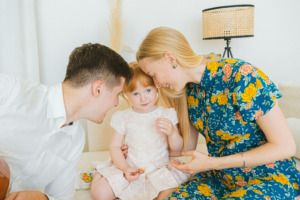
Regulation Is Felt Before It Is Learned
Children experience regulation in their bodies long before they understand it cognitively. This is why explanations often fail in moments of overwhelm.
A child who is emotionally flooded is not resisting support.
They are unable to access it.
When safety is present—through calm tone, grounded presence, and emotional attunement—the child’s body begins to settle naturally. Regulation becomes possible because the nervous system no longer feels threatened.
Why Techniques Can Backfire When Safety Is Missing
Many parents blame themselves when strategies don’t work. In reality, the issue is rarely effort—it is timing.
Techniques offered too early can:
- increase pressure
- signal that emotions need to stop
- create performance around calming down
- disconnect children from their internal experience
Children don’t need to be managed out of emotion. They need support while emotion moves through them.
Safety Is the Precursor to Self-Soothing
Self-soothing is not a skill children are born knowing. It develops through repeated experiences of being emotionally held.
This happens when:
- emotions are allowed without punishment
- presence is steady rather than reactive
- the adult remains regulated
Over time, the child’s nervous system learns that feelings are not dangerous—and self-soothing begins to emerge organically.
Many parents were never shown what emotional safety looks like in real time. They were taught to stop emotions, move past them quickly, or handle them alone. When these parents are now asked to support their children differently, it can bring up confusion, grief, or self-doubt. This is not a failure—it is a moment of awareness. Learning to slow down, stay present, and allow emotion to exist without needing to fix it is a skill most adults are learning for the first time. When parents give themselves permission to practice safety alongside their children, something powerful happens: the home becomes a place where emotions are not problems to solve, but experiences that can be held and understood.
How This Relates to Reiki in Families
Reiki supports emotional regulation not by forcing calm, but by creating the conditions where calm can arise.
When parents practice presence, awareness, and self-regulation, Reiki becomes an energetic environment rather than a technique. Children respond to this environment instinctively.
This is why Reiki works best in families when it is lived first—modeled quietly—before it is ever taught.
To explore how children learn emotional patterns through observation and environment, you may find this article supportive:
https://wendylynnjohnson.com/creating-emotional-safety-family-system/
Conclusion: Safety Before Skil
Children do not need to be fixed.
They need to feel safe.
When safety comes first, skills develop naturally. When presence replaces pressure, regulation becomes accessible. And when families understand this sequence, healing no longer feels complicated.
This is where Reiki quietly supports families—not as a solution to emotions, but as a pathway to safety, awareness, and connection.
For a grounded explanation of why emotional safety is essential for regulation, this resource offers helpful insight: psychologytoday.com/us/basics/emotional-safety