Stressful Moments Are Where the Practice Matters Most
Most parents imagine calm practices happening during calm moments. Quiet rooms. Soft lighting. Time carved out just for self-care.
But real life rarely looks like that.
Stressful parenting moments are loud. They are messy. They happen when children are already overwhelmed and when adults are stretched thin. These are the moments when self-Reiki matters most—not because it fixes everything, but because it steadies us.
Self-Reiki is not meant to be saved for ideal conditions. It is meant to support us in the middle of real life.
A Caregiver Reality
In a childcare setting, stress does not arrive one child at a time. It arrives in waves.
There may be multiple children crying at once. One child melting down while another needs help with a transition. Noise, movement, and emotional intensity all happening simultaneously.
Having spent years in a licensed in-home childcare environment, I know how quickly a caregiver’s nervous system can become overwhelmed. I also know how much pressure caregivers feel to remain calm, regulated, and present—often without support.
If I had known then what I know now, self-Reiki would have been one of the most valuable tools available to me and my employees.
Not as something to do to the children—but as something to support ourselves first.
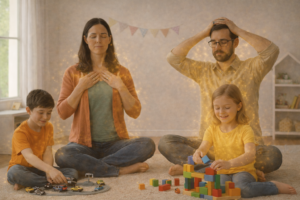
Self-Reiki Begins With the Adult Nervous System
When multiple children are dysregulated, the adult nervous system becomes the anchor. Children borrow regulation from the adults around them. If the adult is overwhelmed, children feel it immediately.
Self-Reiki during stressful moments looks simple:
- a pause before responding
- a hand placed gently on the body
- one conscious breath
- softening the shoulders
- grounding attention inward
These moments do not stop the noise instantly. They stabilize the person holding the space.
And that changes everything.
Why This Matters in Group Care Settings
In group environments like daycare or preschool, children are constantly responding to one another’s energy. When one child escalates, others often follow.
When caregivers use self-Reiki to regulate themselves, the entire room begins to settle—often without words.
This is not magic.
It is nervous system communication.
Calm is contagious.
To explore how emotional and energetic patterns are absorbed through caregiving environments, this article may be helpful:
Energetic Blueprint Children Learn From
https://wendylynnjohnson.com/energetic-blueprint-children-learn-from/
Understanding Children Without Labeling Them
In childcare and parenting alike, adults often search for answers when a child struggles. Why does one child melt down easily while another seems unaffected? Why does one need repetition while another moves quickly?
Frameworks such as Human Design—when used gently—offer insight into how children process information, stimulation, and emotion. They help explain why one child needs more rest, another more movement, and another more space to integrate.
Understanding design removes judgment.
Instead of asking, “What’s wrong?”
We begin asking, “What does this child need?”
This awareness supports both caregivers and families—especially in high-stress environments.
Self-Reiki for Employees and Caregivers
Self-Reiki is not only beneficial for parents. It is invaluable for caregivers and educators who hold space for many children every day.
When adults in caregiving roles have tools to regulate themselves:
- burnout decreases
- patience increases
- emotional resilience grows
- families feel more supported
Caregivers do not need to carry everything alone.
Self-Reiki offers support without adding another responsibility.
For insight into how caregiver regulation impacts children in group settings, this resource offers grounded perspective:
https://www.childmind.org/article/helping-caregivers-manage-stress/
Stress Does Not Mean Failure
Stressful moments do not mean a caregiver or parent is doing something wrong. They mean the nervous system is being asked to hold a lot.
Self-Reiki does not erase stress.
It allows us to stay present within it.
That presence is what children feel.
Conclusion: Regulation Leads Before Resolution
In parenting and caregiving, resolution comes later. Regulation comes first.
When adults learn to use self-Reiki during stressful moments—whether at home or in childcare settings—they create environments where children feel safer, calmer, and more understood.
This is not about perfection.
It is about support.
And support begins with the one holding the space.