Differences Explain Experience — Not Identity
Every child experiences the world differently. Some feel deeply, some move quickly, some withdraw when overwhelmed, and others express emotion outwardly. These differences are often misunderstood as problems to fix rather than information to understand.
When parents begin to view differences as explanatory rather than defining, something important shifts. The focus moves away from labeling and toward compassion.
Why Differences Are Often Misread
Many adults grew up in environments where emotional variation was not well supported. Children were expected to behave similarly, cope similarly, and respond similarly—regardless of temperament, sensitivity, or nervous system needs.
As a result, differences were often framed as:
- being “too much”
- being “too sensitive”
- being “difficult”
- being “behind”
These interpretations were never about the child’s identity. They were reflections of environments that lacked the tools to support variation.
Experience Shapes Expression
Children respond to the world based on how their nervous systems process stimulation, emotion, and change. This means that two children in the same family can experience the same moment in entirely different ways.
Understanding this helps parents pause before assigning meaning to behavior. A child’s response is not a statement about who they are—it is information about what they are experiencing.
When this distinction is honored, emotional safety increases naturally.
How Energy Awareness Supports Understanding
Energy awareness invites curiosity instead of judgment. Rather than asking, “What’s wrong with my child?” parents begin to ask, “What is my child experiencing right now?”
Practices like Reiki support this shift by calming the nervous system and softening emotional reactivity. When parents feel regulated, they are better able to observe without interpreting difference as defiance or failure.
This creates space for children to feel seen without being categorized.
If you’d like to explore how emotional patterns are absorbed and reflected within the family environment, this article may be helpful:
https://wendylynnjohnson.com/energetic-blueprint-children-learn-from/
Moving Away From Labels, Toward Support
Labels can sometimes offer temporary explanation, but they often carry unintended weight. Children may begin to identify with them rather than understand themselves beyond them.
Support, on the other hand, adapts. It meets the child where they are without narrowing who they can become.
This approach benefits parents as well—especially those who grew up without emotional permission themselves. Many adults discover that honoring their child’s differences helps them reconnect with their own unmet needs.
Child development and temperament overview (CDC)
https://www.cdc.gov/child-development/about/index.html
A Core Principle to Hold
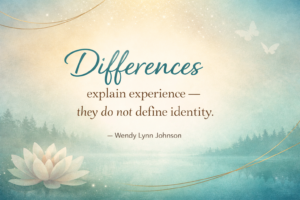
Differences explain experience — they do not define identity.
This principle protects both children and parents from comparison, shame, and unrealistic expectations. It keeps the focus on relationship rather than performance.
Conclusion
When families learn to interpret differences as insight rather than identity, emotional safety deepens. Children feel less pressure to fit a mold, and parents feel more confident responding with presence instead of correction.