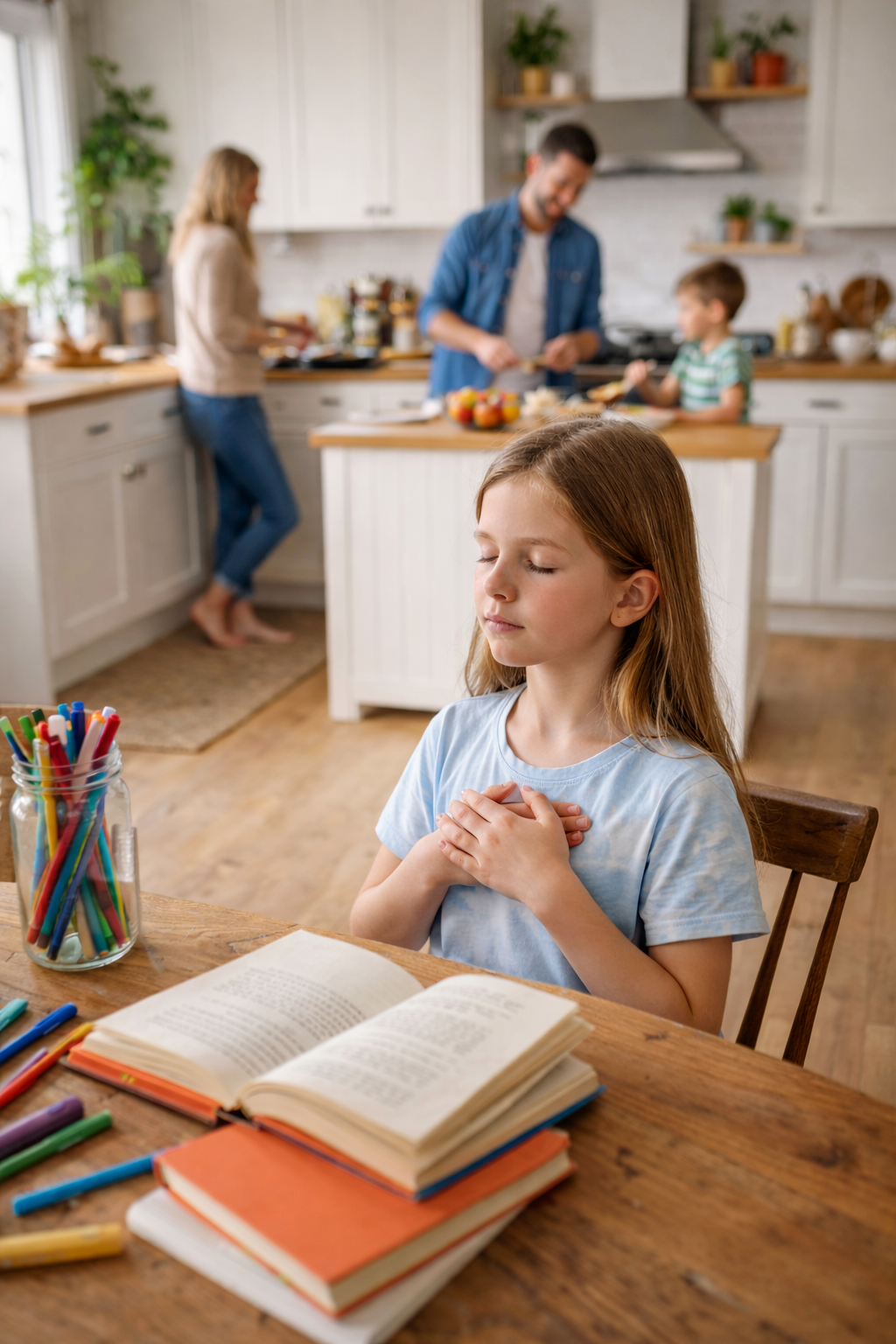
When Children Begin Exploring Self-Soothing on Their Own
Children do not need to be taught how to soothe themselves before they are ready. They need to feel what regulation looks like first.
When parents consistently model presence, self-care, and emotional awareness, something subtle begins to unfold. Children start experimenting on their own. Not because they were instructed to—but because the environment made it possible.
This is one of the most beautiful moments in family healing: when a child reaches inward not out of fear, but curiosity.
Self-Soothing Emerges From Safety
Children only explore self-regulation when their nervous system feels safe enough to do so. This safety does not come from correction, discipline, or explanation. It comes from repeated experiences of being near a regulated adult.
When parents pause, breathe, place their hands on their body, or quietly tend to themselves with care, children absorb that information. Over time, the child’s body learns:
- emotions can be felt without danger
- intensity can soften
- support is available internally
Self-soothing does not begin as a technique. It begins as a felt permission.
- Child Mind Institute – Teaching Kids Self-Regulation
https://childmind.org/article/self-regulation/
What This Looks Like in Real Life
Parents often notice these moments unexpectedly.
A child may:
- place their hands on their chest or stomach when upset
- step away briefly instead of escalating
- take a deep breath without being prompted
- ask for quiet or space
- mirror calming gestures they’ve observed
These actions are not rehearsed. They are intuitive responses emerging from an environment that supports regulation.
This is not independence being forced.
It is capacity being built.
- Self-Reiki as a Daily Practice for Parents
https://wendylynnjohnson.com/blog/self-reiki-as-a-daily-practice-for-parents/
Reiki as a Familiar Presence
When Reiki is part of the home through parental self-practice, children become familiar with its rhythm long before they understand its language.
They sense:
- the slowing of energy
- the quieting of emotion
- the steadiness that follows
Reiki becomes associated with comfort and safety rather than something external or imposed. For children, this familiarity is key. It allows self-soothing behaviors to arise organically, without pressure or expectation.
Children do not need to know they are “doing Reiki.”
They only need to feel supported.
Honoring the Child’s Pace
Not all children explore self-soothing in the same way or at the same time. Some children are physical. Some are emotional. Some are highly sensitive. Others are more reserved.
What matters is not how it looks—but that it remains optional.
Children should never be asked to regulate before they have the capacity. When given space, trust, and modeling, their natural intelligence leads the way.
This is where parents often notice a shift from managing behavior to supporting development.
Preparing the Ground for Future Learning
These early moments of self-soothing are not formal practice. They are seeds.
As children grow, these seeds may later support:
- emotional resilience
- intuitive awareness
- self-trust
- readiness for deeper learning
If families eventually choose to explore Reiki together more intentionally, children already recognize the feeling of regulation. The body remembers.
Learning becomes an extension of lived experience rather than something new to master.
Closing Reflection
When children begin soothing themselves, it is not because they were taught to cope.
It is because they were allowed to feel.
Parents who model self-care create homes where children learn to listen inward, trust their bodies, and respond to emotion with curiosity instead of fear.
This is how healing becomes relational.
This is how energy awareness becomes natural.
This is how families grow together.