Self-Care Is Never Isolated
When we think of self-care, we often picture something private—something we do for ourselves. A quiet moment. A breath. A practice meant to refill our own cup.
But true self-care never stays contained.
When we regulate ourselves, soften our nervous system, and bring our energy back into balance, the effects ripple outward. Children feel it. Pets feel it. The entire household responds.
Self-care is relational by nature.
Children and Animals Feel Energy Before Words
Children and animals share something profound: they respond to energy long before they understand language or logic.
A child does not need to be told that a parent is calm—they feel it.
An animal does not need explanation—they respond instantly to presence.
When we practice self-Reiki, we shift our internal state. That shift communicates safety without effort.
This is why self-care is not selfish. It is one of the most generous acts we can offer those who depend on us.
The Natural Connection Between Reiki and Animals
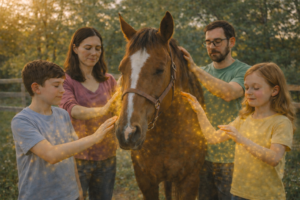
Animals are especially receptive to Reiki because they do not question it. They do not analyze it. They do not resist it.
Reiki meets animals in the language they already speak—sensation, calm, and presence.
Many pets respond to Reiki by:
- relaxing their bodies
- settling near the practitioner
- slowing their breathing
- becoming visibly calmer
This response is instinctual. Reiki feels familiar to animals because it mirrors the natural energy exchange found in nature.
How Self-Reiki Supports Pets Without Effort
One of the most beautiful aspects of Reiki is that it does not require intention directed outward to be beneficial.
When a parent or caregiver practices self-Reiki:
- animals often come closer
- pets settle beside or near them
- anxious behaviors soften
This happens because animals feel the shift in the environment. Calm becomes available, and they move toward it naturally.
No training is required.
No instruction is necessary.
Presence does the work.
To understand how children absorb emotional and energetic patterns from their environment, this article offers supportive context:
Energetic Blueprint Children Learn From
https://wendylynnjohnson.com/energetic-blueprint-children-learn-from/
Modeling Care for All Living Beings
Children learn how to care for themselves by watching how adults care for others—especially those who cannot speak for themselves.
When children see parents offering gentleness to pets, they internalize that care is not conditional. It is not earned through behavior. It is offered because connection matters.
This modeling teaches children:
- compassion without instruction
- empathy without correction
- regulation through presence
These lessons last far longer than words.
Reiki as a Family Practice
In families where Reiki is part of daily life, it becomes woven into ordinary moments.
A parent placing their hands on their heart.
A child resting nearby.
A pet curling up at their feet.
Nothing dramatic is happening—and yet everything is.
Reiki becomes a shared language of calm.
For insight into Reiki’s calming effects for animals, this resource offers grounded perspective:
https://www.reiki.org/articles/reiki-animals
Caring for Those Who Cannot Care for Themselves
Self-care does not stop with us. It extends naturally to children, animals, and anyone who relies on our stability.
When we regulate ourselves:
- children feel safer
- pets feel calmer
- homes feel steadier
This is not because we are doing more.
It is because we are being more present.
Conclusion: Calm Is a Shared Experience
Self-care is not a retreat from responsibility—it is a foundation for it.
When we practice self-Reiki, we care not only for ourselves, but for the children who look to us for safety and the animals who trust us instinctively.
Calm does not belong to one person in the home.
It belongs to everyone who lives there.