Receiving Reiki and Learning Reiki Are Not the Same
One of the most common questions parents ask is, “When is my child ready for Reiki?”
To answer that clearly, we must first separate two very different experiences.
Children of any age can receive Reiki.
A parent can gently offer Reiki to a crying baby, a toddler having a hard moment, or a child experiencing anxiety. Reiki is safe, non-invasive, and supportive. It does no harm and can be offered with loving intention at any stage of life.
When we talk about readiness, we are not talking about receiving Reiki.
We are talking about learning to work with energy intentionally.
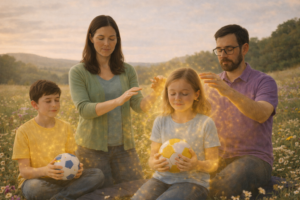
What Readiness Really Means
Readiness is not determined by age, behavior, or emotional maturity. It is not about how calm a child appears or how much they can explain what they are feeling.
Readiness is about capacity.
It is the ability to remain present with sensation, emotion, and awareness without becoming overwhelmed. This capacity develops gradually, through safety, regulation, and repeated experiences of being emotionally supported.
As children build this capacity, they naturally become more able to use gentle energy awareness for self-soothing—such as calming anxiety during a test, settling their nervous system during moments of overwhelm, or reconnecting with themselves when emotions feel big.
Why Timing Matters in Learning
Children are intuitive. They sense expectations quickly. When learning is introduced before a child has the capacity to stay present, even gentle practices can feel like pressure.
Learning Reiki is not about performance.
It is not about “doing it right.”
And it is never something a child should feel responsible for.
Before learning energy practices, children need:
- emotional safety
- permission to feel without correction
- freedom from pressure
- trust in their own inner experience
When these conditions are present, curiosity arises naturally.
When Children Are Not Ready — and Why That’s Okay
Some children are still learning how to feel safe in their bodies. Others are navigating anxiety, sensory sensitivity, or emotional overwhelm. In these moments, the most supportive thing a parent can do is not teach—but model.
Children do not need tools when their nervous system is already overloaded. They need steadiness around them.
This is where parents practicing self-Reiki becomes powerful. Children absorb regulation through proximity, tone, pacing, and presence. Long before they learn Reiki themselves, they learn what calm feels like by being near it.
Learning Reiki as a Family Experience
When families eventually learn Reiki together, the experience is less about instruction and more about shared awareness. Parents and children are not performing a technique—they are learning to listen, notice, and respond with care.
Learning together:
- removes hierarchy
- reduces pressure
- strengthens connection
- normalizes energy awareness
- builds trust across generations
This shared experience allows Reiki to become part of everyday family life rather than something separate or special.
To explore how children learn emotional and energetic patterns through their environment, you may find this article supportive:https://wendylynnjohnson.com/energetic-blueprint-children-learn-from/
Respecting Training and Energetic Integrity
While everyone carries energy and intention, Reiki itself is traditionally learned through structured training. This training supports clarity, safety, and respect for the practice.
Understanding this distinction matters for families.
Reiki is not something to improvise or force. It is something to learn intentionally, when the time is right, with guidance and integrity. This protects children while honoring the practice itself.
Conclusion: Trust the Pace
Children do not need to be rushed into healing.
They need to be met where they are.
When parents trust timing, model regulation, and honor readiness, Reiki becomes an invitation rather than an expectation. In that space, learning unfolds naturally—without pressure, fear, or performance.
This is how Reiki becomes woven into family life: gently, respectfully, and at the pace of safety.
For grounded insight into how emotional awareness and readiness develop in children, this resource offers helpful context:https://www.childmind.org/article/helping-kids-build-emotional-awareness/